Harding
The Caine MutinyHarding is an ensign aboard the USS Caine, where his civilian experience as a professional accountant sharpens his view of the difference between keeping a ship’s records and preparing it to meet danger. He questions whether the ship is ready for its work and whether its captain can lead it through a crisis. Although the narrative gives no account of his later fate, his brief appearances make him a clear voice for the practical obligations that paperwork and formal standards can obscure.
Identity and Introduction
Harding first appears in the ship’s cramped clipping shack, where Willie Keith finds him asleep on a bunk recently welded into the wall. The small metal compartment also holds empty machine-gun ammunition belts and cases, and its temperature is about 105 degrees. The fresh, conspicuous weld and oppressive heat establish the conditions in which the ensign is expected to live and work. His setting is not a private cabin but a makeshift space carved out of the ship’s working area.
Harding’s professional background makes his assignment aboard the USS Caine particularly pointed. He is a graduate accountant who has conducted audits for a commercial company, and he now audits the ship’s service, including its small canteen inventory. He accepts that this work may be useful to the ship, but regards it as subordinate to the Navy’s larger obligation: providing a vessel that can operate and a captain able to fight it. The contrast between his former occupation and wartime service is not a rejection of routine duty; it is an insistence that routine should serve readiness rather than replace it.
Readiness and Command Standards
In conversation with Willie Keith, Harding describes the ship’s service audit as absurdly small-scale beside the demands of war. His concern is not simply that the task resembles his civilian work. He asks what happens if the ship gets into serious trouble, and argues that a captain’s purpose is to get the vessel out of trouble, not merely to check that reports and assignments meet their deadlines. His accounting expertise gives the complaint a particular edge: he knows how an audit should be done, yet sees that procedural competence cannot compensate for a ship or command unprepared for its central purpose.
Harding nevertheless accepts the immediate work assigned to him. He tells Willie Keith that he volunteered for the Navy and will perform the ship-service audit if it helps the USS Caine. What he expects in return is not personal reward, but a seaworthy ship and a captain who can act effectively in combat. The exchange presents him as neither dismissive of service nor content to treat every assigned task as sufficient. His standard is practical: administrative work matters insofar as it supports the ship and its crew.
That standard comes into direct conflict with Philip Francis Queeg’s emphasis on excellence. When a senior officer considers Harding for a first-lieutenant position aboard the Oaks, Queeg acknowledges that Harding might be considered qualified on many ships, but says he has not achieved the level of excellence demanded aboard the USS Caine. The officer seeking a first lieutenant argues that the Oaks needs someone with minesweeping knowledge and that people must learn quickly during wartime. Queeg instead maintains that war raises, rather than lowers, the required standard because lives are at stake. The disagreement leaves Harding’s competence caught between an immediate staffing need and the captain’s absolute-sounding criterion; the account establishes the proposed transfer and the dispute over his qualification, but does not state its eventual outcome.
Life Under the Ship’s Rules
Harding’s working life belongs to the wider routine of the USS Caine: watches, coding, corrections to publications, meals, and sleep repeatedly interrupted by duty. During a stretch of rough weather, Willie Keith loses track of time as the officers and sailors move through the ship’s work cycle, with the captain’s demands and the labor of keeping up with publications among its recurring features. The ship’s narrow spaces and broken routine make the difference between formal assignment and lived experience tangible. Harding’s audit is one task within a system that fills nearly all available time.
Philip Francis Queeg’s regulations also produce a pattern of selective compliance. After a cigarette butt is found in a forecastle scupper, the captain cancels the crew’s liberty. The main deck is then kept swept for a time, but the effort fades when the ship sails; a small area along the captain’s usual route remains under special attention. The crew’s observance of the new order gathers around what the captain can see and hear, while life elsewhere aboard continues under informal habits. Harding is not singled out as an organizer of this response, but the pattern supplies the context for his distinction between visible procedure and the ship’s actual condition.
Discipline and the Shipboard Court
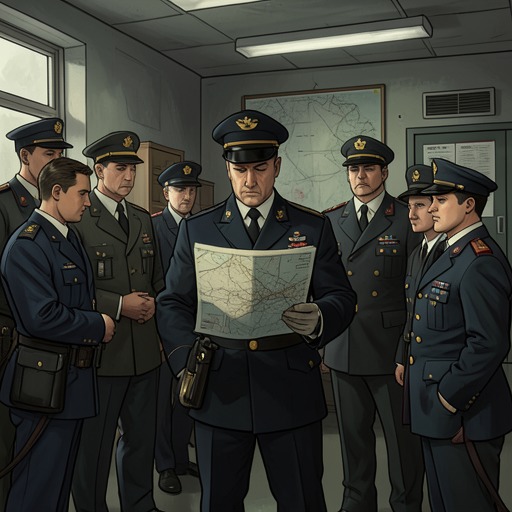
Harding also appears in the proceedings against Gunner’s Mate Stilwell. After Tom Keefer announces the finding and sentence of six lost liberties, Harding tries to maintain a solemn expression, but a grin breaks through. The sentence has little practical effect because Stilwell is already confined, and Willie Keith reads the result as an effective acquittal and an insult to Queeg. Harding’s reaction registers the gap between the court’s formal language and the limited force of its punishment. He is not shown explaining or defending the verdict; the scene instead places him among officers who recognize, at least in that moment, the mismatch between the announced penalty and what it can accomplish.
Narrative Role and Limits
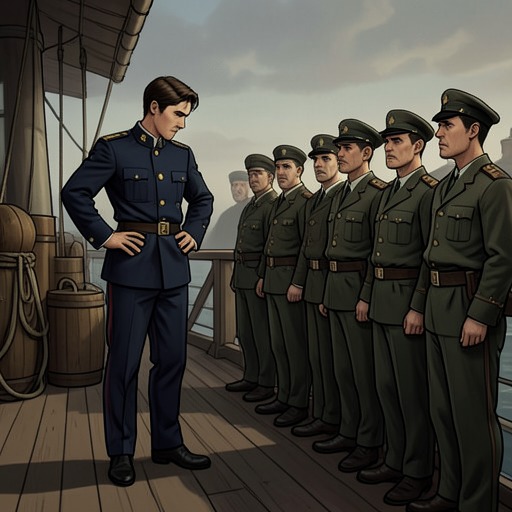
Harding’s role is defined less by an extended personal arc than by the perspective he brings to the USS Caine’s command culture. His account of the audit gives concrete form to a central tension: paperwork and standards can be necessary, yet become hollow when separated from operational readiness. His consideration for service aboard the Oaks further shows that the same standard can be invoked in opposing ways—Queeg uses excellence to resist a wartime appointment, while the officer seeking Harding stresses the need to learn and serve promptly. The shipboard court offers a smaller echo of that tension, as a formal sentence proves almost meaningless in practice.
The novel’s prefatory note identifies the people and events aboard the USS Caine as fictional, within a historical setting whose operational details have been altered. Harding should therefore be read as part of the book’s constructed examination of naval life, not as a portrait of an identified serviceman. The evidence establishes his professional background, his concern for the ship’s fighting capacity, his disputed qualification for another post, and his presence at Stilwell’s hearing; it does not supply a later biography or a final account of his service.